

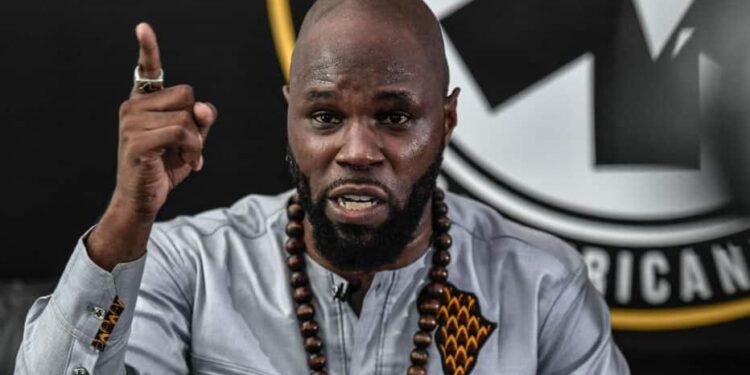
South African police have arrested controversial pan-African activist Kemi Seba, who is wanted in Benin over allegations of inciting rebellion tied to a failed coup attempt, in a case that underscores deepening geopolitical tensions across West Africa.
The arrest highlights growing ideological divisions across West Africa, where anti-West activists and military-led governments are reshaping alliances, particularly in countries affected by recent coup attempts and shifting geopolitical loyalties.
Arrest in Pretoria and alleged escape plan


Authorities confirmed that Seba—born Stellio Gilles Robert Capo Chichi—was detained on Monday at a Pretoria shopping centre alongside his 18-year-old son and a third individual accused of facilitating an illegal border crossing.
Police say the group intended to enter Zimbabwe unlawfully before travelling onward to Europe. The suspected facilitator was allegedly paid around R250,000 ($13,000) to assist the crossing.
According to a police statement, preliminary investigations indicate Seba is a wanted fugitive in both Benin and France for offences linked to crimes against the state.
Extradition process under way
The case has been postponed until April 20, with Seba and his son remaining in custody as extradition proceedings begin.
Benin issued an international arrest warrant on December 12, accusing Seba of ‘justifying crimes against state security and inciting rebellion’ following his public support for a failed coup in Benin, as explored in why Benin’s failed coup worries the Sahel.
A Beninese presidency official told AFP that a delegation would travel to South Africa to oversee the formal extradition process.
Coup attempt and political fallout
The charges stem from a December 7 coup attempt in Benin, where mutinous soldiers briefly claimed to have overthrown President Patrice Talon before being swiftly neutralised.
The uprising was suppressed within hours with reported backing from regional and international partners, including Nigeria and France.
Seba, a long-time critic of Talon, described the attempted overthrow as ‘a day of liberation’ in a video message that later triggered the arrest warrant.
Authorities subsequently detained around 30 suspects, mostly soldiers, while others linked to the plot remain at large.
Anti-West rhetoric and Sahel alignment
Seba has built a significant following through his outspoken criticism of France and African governments perceived as aligned with Paris. As leader of Urgences Panafricanistes, he commands an audience of roughly 1.5 million followers online.
His messaging has resonated in countries such as Mali, Burkina Faso and Niger, where military governments have adopted increasingly anti-West positions.
His activism aligns with a broader wave of anti-West sentiment across the Sahel, where military-led governments have distanced themselves from former colonial powers.
He has also faced scrutiny over past legal troubles in Europe, including his detention in France, as reported in his arrest in Paris, before being released.
Born in France to Beninese parents, Seba has been convicted multiple times in France for incitement to racial hatred and was stripped of his French nationality in 2024.
He reportedly holds a Nigerien passport granted by the junta that seized power in 2023, further complicating extradition dynamics. Sources indicate he has expressed a preference to be sent to Niger rather than Benin.
His rhetoric and alliances have drawn attention amid shifting geopolitical alignments across the Sahel, particularly as countries pivot away from Western influence.
The case unfolds against growing scrutiny of Benin’s political environment. Critics have accused former president Patrice Talon of weakening democratic institutions during his tenure.
Opposition figures have faced imprisonment or exile, while journalists have also come under pressure. In 2025, a Beninese journalist was detained during an event in Cote d’Ivoire before being returned home.
Talon’s successor, Romuald Wadagni, secured more than 94 percent of the vote in a landslide election, a result examined in Benin’s recent presidential vote, which has raised further questions about political pluralism in the country.




