Nigeria has urged the global maritime community to ensure fairness, equity, and stronger support for developing economies in shipping’s transition to net-zero emissions.
The call came during the 84th session of the Marine Environment Protection Committee, organised by the International Maritime Organisation (IMO) in London.
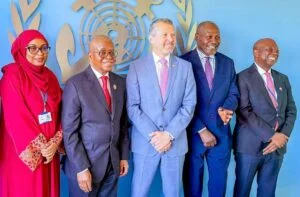
Nigeria’s Minister of Marine and Blue Economy, Dr Adegboyega Oyetola, led the country’s delegation at the high-level gathering.

This is contained in a statement issued on Sunday in Lagos by the minister’s Special Adviser, Dr Bolaji Akinola.
Oyetola reaffirmed Nigeria’s support for global decarbonisation efforts within international shipping and maritime operations.
He, however, stressed that climate frameworks must recognise the economic circumstances and development priorities of emerging economies.
“Decarbonisation must not become an additional burden on developing countries already confronting economic and infrastructure limitations,” the minister said.
He maintained that any transition plan must promote inclusion, fairness, and balanced responsibility among maritime nations.
Oyetola said the global push toward net-zero emissions by 2050 must align with broader sustainable development objectives.
According to him, environmental progress should not undermine economic growth, trade competitiveness, or social stability in developing states.
“Climate ambition must go hand in hand with development realities and shared global responsibility,” he added.
On the sidelines of the committee meeting, Oyetola held strategic discussions with top international maritime leaders.
He met with IMO Secretary-General, Arsenio Dominguez, during talks focused on strengthening Nigeria’s engagement with the organisation.
The minister also met the President of Saudi Arabia’s Transport General Authority, H.E. Fawaz Al Sehali.
During the engagements, Oyetola reaffirmed Nigeria’s commitment to deeper international cooperation across critical maritime priorities.
Discussions centred on maritime security, technical cooperation, capacity building, blue economy development, and a fair energy transition.
He said Nigeria remained committed to partnerships built on mutual trust, shared responsibility, and long-term strategic interests.
“Our cooperation with the IMO remains anchored on maritime safety, institutional growth, and sustainable economic development,” Oyetola stated.
He said Nigeria was prepared to contribute meaningfully to shaping a more inclusive global maritime future.
Meanwhile, Dominguez expressed appreciation for the warm reception he received during his recent official visit to Nigeria.
He particularly referenced his meeting with President Bola Tinubu as significant and encouraging.
“The engagement reflected Nigeria’s seriousness and commitment to global maritime governance,” Dominguez said.
He also commended Nigeria’s leadership role in improving maritime security across the Gulf of Guinea.
According to him, the country has recorded notable progress in combating piracy and strengthening regional coordination.
“Nigeria’s experience offers practical lessons for other maritime regions facing similar security threats,” he said.
The News Agency of Nigeria (NAN) reports both parties also discussed Nigeria’s growing influence within the IMO Council and ongoing institutional reforms.
The talks examined port modernisation, digital transformation, and efforts to strengthen human capital in the maritime sector.
Nigeria’s engagement with Saudi Arabia also highlighted expanding bilateral cooperation within the global maritime community.
Both countries reaffirmed their commitment to mutual support and stronger collaboration under the IMO framework.