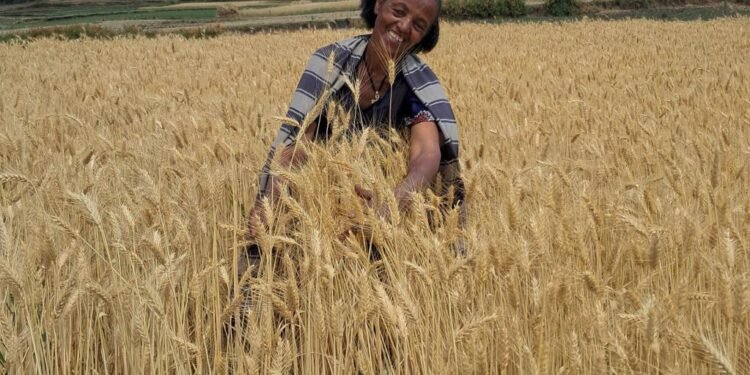
Ethiopia has emerged as Africa’s largest wheat producer after recording a historic harvest of more than 33 million tonnes, marking a major milestone in the country’s drive towards food self-sufficiency and agricultural expansion.
Prime Minister Abiy Ahmed announced the achievement during a visit to large-scale wheat farms in the Oromia region, where officials highlighted the rapid transformation of Ethiopia’s agricultural sector over recent years. According to state-affiliated media reports cited by TV BRICS and Fana Media Corporation, wheat output surpassed 330 million quintals during the current fiscal year. The milestone also highlights Ethiopia’s effort to reduce food imports and position itself as a regional grain supplier amid growing concerns over global food insecurity.
Irrigation expansion drives output


The latest figures underline Ethiopia’s aggressive push to expand irrigated farming and reduce dependence on imported grain. Officials said more than eight million hectares of land were cultivated during both the main rainy season and the summer farming cycle.
The government attributed the sharp increase in wheat production to expanded irrigation schemes, improved seed varieties and the wider use of mechanised farming methods. Wheat output reportedly rose by about 50 million quintals compared with the previous harvest season.
Speaking during the farm inspection tour, Abiy said Ethiopia’s agricultural reforms were reshaping rural livelihoods and strengthening national food security.
The achievement also builds on Addis Ababa’s broader agricultural diplomacy strategy. The achievement also builds on Addis Ababa’s broader agricultural diplomacy strategy. Africa Briefingpreviously reported that Abiy received a UN food and agriculture medal recognising Ethiopia’s food security initiatives and rural transformation agenda.
Officials said land previously left uncultivated had now become productive farmland through irrigation development and better resource management. According to the Ethiopian leader, the country’s wheat expansion demonstrates that Ethiopia can significantly reduce its reliance on imported staples while creating economic opportunities for farmers.
From importer to regional producer
Ethiopia’s rise as Africa’s leading wheat producer represents a dramatic turnaround for a country that once relied heavily on grain imports and food assistance during periods of drought and economic instability.
Agricultural analysts say the government’s focus on climate-resilient irrigation systems has played a critical role in boosting production, particularly as changing weather patterns continue to threaten rain-fed farming across Africa. The International Maize and Wheat Improvement Centre has previously highlighted Ethiopia’s irrigated wheat programme as a model for improving climate resilience and crop productivity in drought-prone regions.
The country has increasingly promoted summer wheat cultivation in lowland regions, an approach officials say was previously uncommon in Ethiopia. Authorities now view the strategy as central to long-term food sovereignty plans.
The agricultural push has also been supported by efforts to improve fertiliser access and industrial inputs. Africa Briefing previously reported on Ethiopia’s fertiliser partnership with Dangote, which officials said would help improve agricultural productivity and strengthen food supply chains.
Young farmers and digital agriculture
The government’s wider agriculture strategy has also encouraged youth participation and digital awareness campaigns aimed at modernising farming practices.
In a related development, Africa Briefing recently highlighted how a young Ethiopian farmer is using social media to promote sustainable agriculture, reflecting a growing movement among younger farmers embracing innovation and climate-smart farming techniques.
State Minister for Agriculture Eyasu Elias recently described Ethiopia as Africa’s leading wheat producer, noting that sustained policy support and investment had accelerated the sector’s growth.
The government’s broader agricultural strategy forms part of Ethiopia’s effort to strengthen food security while conserving foreign exchange reserves previously spent on grain imports.
Officials believe the latest wheat harvest could eventually position Ethiopia as a regional wheat exporter if production continues to rise. Abiy has previously suggested that the country could target output levels of up to 50 million tonnes in the coming years.
Agriculture remains a cornerstone of Ethiopia’s economy, employing a large share of the population and contributing significantly to export revenues. Beyond wheat, the country is also Africa’s leading coffee producer and exporter.
Experts say Ethiopia’s wheat gains could offer lessons for other African countries seeking to reduce dependence on imported food amid rising global commodity prices and climate-related disruptions.
However, analysts caution that sustaining production growth will require continued investment in irrigation infrastructure, rural financing, fertiliser access and climate adaptation programmes.